Top 20 Songs With Good Intros
Discover the 20 best song intros of all time — from Nirvana's "Smells Like Teen Spirit" to Queen's "Under Pressure." Learn what makes each iconic opening unforgettable.

The intro of a song often sets the tone, capturing listeners’ attention from the first few seconds. Great intros not only grab the listener's attention but also create anticipation for the rest of the track, significantly impacting a song’s success. In a streaming-focused world, a memorable opening can make or break a song’s impact. On Spotify alone, listeners decide whether to skip a track within the first few seconds — making a compelling intro one of the most important factors in whether your song gets played through or passed over. Here, we explore 20 of the best song intros of all time, spanning genres and decades.
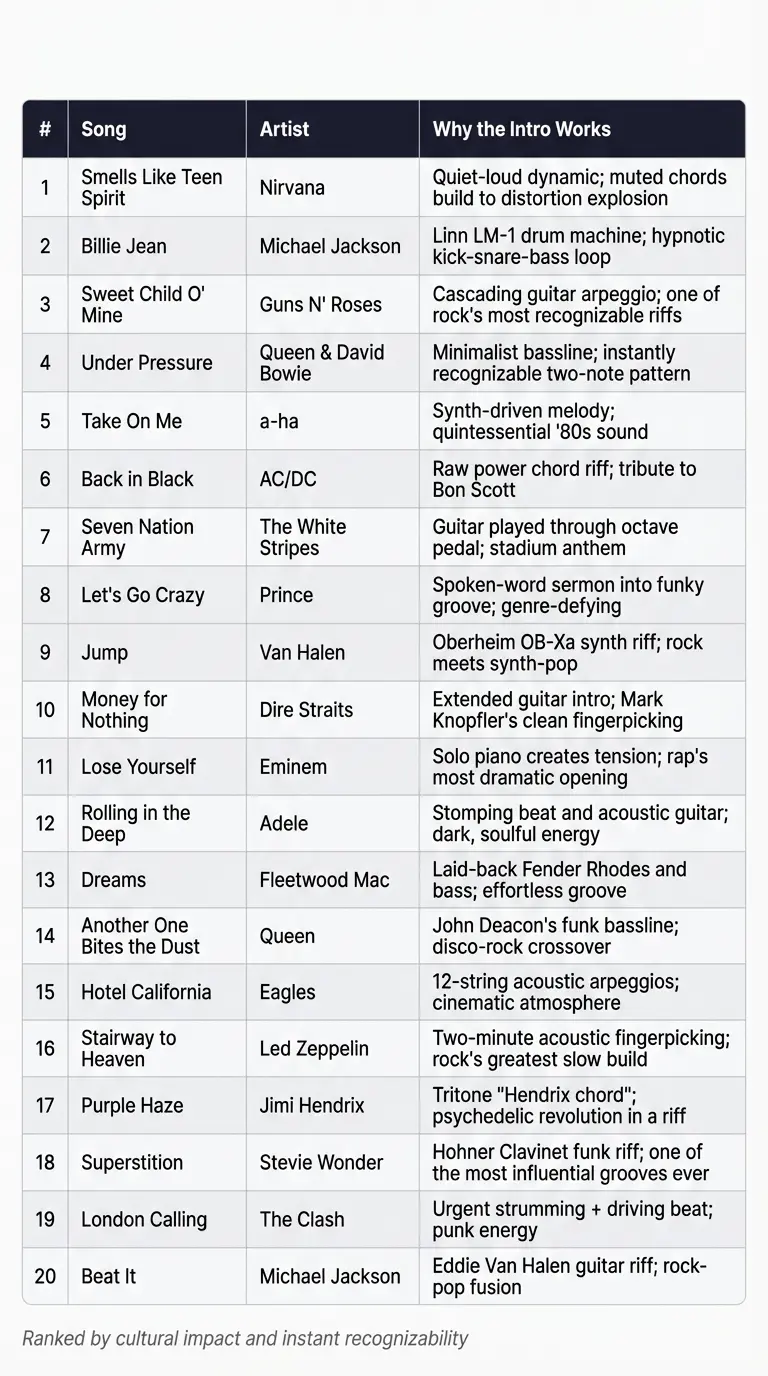
The 20 Greatest Song Intros of All Time, Ranked
"Smells Like Teen Spirit" – Nirvana
A grunge anthem with one of rock's most recognizable intros, combining power chords and angst-filled riffs. Kurt Cobain's four-chord opening — played clean, then exploding into distortion — became the blueprint for the quiet-loud dynamic that defined 1990s alternative rock. Producer Butch Vig captured the raw energy of a band that sounded like they were barely holding it together, which was exactly the point.
What makes this intro especially effective is its restraint. There are over 25 seconds of instrumental setup before Cobain sings a single word — a luxury that modern streaming-era songs rarely afford. The muted guitar strumming that opens the track creates tension and anticipation, making the distorted explosion that follows feel like a release. It's a masterclass in dynamics.
"Billie Jean" – Michael Jackson
The intro that almost never was. Producer Quincy Jones wanted to cut the 29-second opening — then the longest intro on a pop single — arguing it was too long for radio. Michael Jackson refused, telling Jones it was the part that made him want to dance. The compromise? Nothing was cut, and those 29 seconds became arguably the most recognized drum pattern in pop music history. Recorded using a Linn LM-1 drum machine — one of the first drum machines capable of using real samples — the intro's crisp kick-and-snare pattern became one of the most imitated grooves in pop music history.
Engineer Bruce Swedien built a custom drum platform and placed a flat piece of wood between the snare and hi-hat to achieve what Jones called "sonic personality" — a sound no one had heard before. Drummer Leon "Ndugu" Chancler played live alongside a Linn LM-1 drum machine, syncing his performance to the machine's pattern so precisely that it's nearly impossible to tell where one ends and the other begins. The bass was played by Louis Johnson of the Brothers Johnson on a Yamaha bass, while a Yamaha CS-80 synthesizer added those eerie, atmospheric chords that float above the groove. Swedien mixed the song 91 times before settling on the second mix. The result is an intro you can identify from its first three beats alone.
"Sweet Child O' Mine" – Guns N' Roses
In 1986, Slash was sitting on the floor of the band's shared Hollywood house — a place so bare they didn't even have furniture — when he started playing a circular, arpeggiated guitar pattern. He later dismissed it as just "messing around and putting notes together," though legend long held it was a warm-up exercise. Rhythm guitarist Izzy Stradlin heard it from across the room, started playing chords underneath, and Duff McKagan locked in a cascading bassline. Upstairs, Axl Rose was listening. A couple of days later at rehearsal, he asked the band to play that riff again — and revealed he'd already written a full set of lyrics to it.
The riff itself is built on an arpeggiated pattern in D major played on a Gibson Les Paul tuned down a half step to E♭. It was recorded at Rumbo Recorders in Los Angeles with producer Mike Clink, and Slash has said the intro was the hardest part to nail in the studio — it took him an entire afternoon to time it perfectly against the drums. Voted the greatest guitar riff of all time by Total Guitar magazine readers in 2004, it's the rare intro that even people who've never picked up a guitar can hum note for note.
"Under Pressure" – Queen & David Bowie
This collaboration happened entirely by accident. In July 1981, Queen were recording at their own Mountain Studios in Montreux, Switzerland, when David Bowie — who lived nearby — dropped in for what was supposed to be a quick visit. What started as a casual jam session turned into an all-night writing marathon that producer Dave Richards called "complete madness in the studio."
The iconic bassline — just seven notes, six of them identical — was created by Queen bassist John Deacon during the session. When the band broke for dinner, Deacon came back and couldn't remember what he'd played. According to different accounts, it was either Roger Taylor or Bowie himself who recalled the riff, with Bowie slightly altering Deacon's original pattern into the version we know today. Stylus magazine later named it the greatest bassline in popular music history. The creative tension between Freddie Mercury and Bowie was intense — Brian May recalled that the two "locked horns" throughout the session — but that friction is exactly what gave the song its raw, almost combustible energy. The vocals were recorded blind: Mercury and Bowie each went into the booth without knowing what the other had sung, trading verses through pure improvisation.
"Take On Me" – a-ha
The synth riff that defines this song nearly didn't survive the recording process. Keyboardist Magne Furuholmen and guitarist Pål Waaktaar first wrote the central melody as teenagers in their band The Bridges, with Waaktaar initially dismissing it as "too cheesy and poppy." Years later, the riff went through three dramatically different recordings before becoming a hit.
The first producer, Tony Mansfield, replaced a-ha's original Roland Juno-60 sound with a Fairlight CMI — one of the most expensive digital synthesizers of the era — and stripped the tension-building intro from the arrangement entirely. The band hated the result. When Alan Tarney took over production in 1985, he did the opposite: he went back to the original demo and rebuilt the track around the warmth of the band's analog synths, layering the Juno-60, a PPG Wave, and a Yamaha DX7 bass patch underneath. A LinnDrum provided the punchy, programmed beat. The finished intro builds tension for nearly 20 seconds with a pulsing four-on-the-floor beat before the riff erupts — a structure that rewards the listener's patience. Combined with Morten Harket's jaw-dropping vocal range spanning over two and a half octaves (including a soaring falsetto E5), the intro delivers a rush of pure synth-pop euphoria that hasn't aged a day.
"Back in Black" – AC/DC
The opening seconds of this track carry weight that extends far beyond the music itself. Released in 1980, Back in Black was AC/DC's first album after the death of original singer Bon Scott, and the opening hi-hat count followed by Angus Young's grinding guitar riff served as both a statement of survival and a defiant return. The song was conceived as a tribute to Scott, and that tolling bell-like quality in the riff reflects the album's jet-black cover — a mourning band designed as a mark of respect.
Producer Robert John "Mutt" Lange shaped the guitar tone by having brothers Angus and Malcolm Young play their parts through a wall of Marshall amplifiers at Compass Point Studios in the Bahamas. Malcolm's rhythm guitar, often the unsung engine of AC/DC's sound, locks into a tight groove that gives the riff its locomotive force. There are no keyboards, no studio tricks — just two guitars, bass, drums, and the raw swagger of new vocalist Brian Johnson. The intro lasts barely ten seconds before Johnson's raspy howl takes over, but those ten seconds have opened countless stadium concerts, sports events, and movie scenes. It's the sound of hard rock at its most stripped-down and powerful.
"Seven Nation Army" – The White Stripes
One of the most universally recognized riffs of the 21st century didn't come from a bass guitar at all. Jack White played the main riff on a semi-acoustic Kay hollow body guitar run through a DigiTech Whammy pedal set to shift the pitch down one octave, giving it the deep, growling quality that listeners often mistake for a bass. The White Stripes, famously, had no bassist — just White on guitar and Meg White on drums.
Recorded in 2003 at Toe Rag Studios in London on vintage eight-track equipment, the production deliberately avoided modern recording techniques. The riff itself is built on just seven notes descending in a hypnotic, march-like pattern in the key of E. What makes it so effective as an intro is its simplicity: a single melodic line with no chords, no harmonies, and no drums for the first several seconds. It's so singable that it has been adopted as a stadium chant by football fans across Europe, often sung by tens of thousands of people who may never have heard the original recording. For independent artists, it's a powerful reminder that a memorable hook doesn't require complexity — just the right melody at the right moment.
"Let’s Go Crazy" – Prince
Prince opens this track not with music but with a spoken-word sermon delivered over a swirling organ — a deliberate, theatrical choice that sets up the song's theme of living life to the fullest before "the elevator" takes you down. The speech lasts nearly 30 seconds before an explosive pivot into one of the most energetic guitar-driven grooves of the 1980s.
The transition from preacher to performer is what makes this intro unforgettable. Recorded at Prince's own studio in Chanhassen, Minnesota, for the Purple Rain soundtrack in 1984, the organ intro was played on a Yamaha CP-70 electric grand piano, and the subsequent guitar-heavy explosion features Prince playing a custom-built Cloud guitar. The contrast is the entire point: restraint giving way to abandon, contemplation erupting into celebration. It's a technique that mirrors the quiet-loud dynamics of rock but filtered through Prince's genre-bending sensibility — equal parts funk, rock, new wave, and gospel. The sermon-to-explosion format also made it one of the most electrifying concert openers of the Purple Rain tour, where it served as the show's opening number.
"Jump" – Van Halen
When Eddie Van Halen first played the synth riff that would become "Jump" for his bandmates, vocalist David Lee Roth hated it. Roth wanted Van Halen to remain a guitar band and resisted the idea of building a song around a keyboard. Eddie had been tinkering with the Oberheim OB-Xa synthesizer for years, and the bright, brass-like patch he'd programmed for "Jump" sat in a drawer until producer Ted Templeman convinced the band to record it for their 1984 album 1984.
The result changed rock radio overnight. That opening synth stab — bold, major-key, and impossibly upbeat — announced that hard rock could embrace synthesizers without losing its edge. Eddie layered the OB-Xa with a Minimoog for the bass tone, but it's the OB-Xa's punchy, stacked-voice patch that dominates the intro. The song was recorded at Eddie's personal 5150 Studios, one of the first truly professional home studios in rock. The intro runs just eight bars before Alex Van Halen's drums crash in and Roth's exuberant vocal takes over, but those eight bars single-handedly broadened what a Van Halen song could be — and what arena rock could sound like.
"Money for Nothing" – Dire Straits
Mark Knopfler's opening guitar riff on this track is one of the most sonically distinctive in rock history, and it didn't come from his usual Fender Stratocaster. For the recording at AIR Studios in Montserrat in 1984, Knopfler used a Gibson Les Paul through a Laney amplifier to get the heavy, overdriven crunch that was deliberately different from his signature clean fingerpicking style.
But the intro doesn't start with the guitar. It begins with a synthesizer drone and Sting's falsetto vocal hook — Sting happened to be recording with The Police at the same studio and contributed the melody, earning him a co-writing credit. The guitar riff doesn't fully arrive until nearly a minute into the track, building through layers that producer Neil Dorfsman crafted with unusual patience. At over two minutes, the full instrumental introduction is one of the longest of any chart-topping single of the 1980s. The extended buildup was a gamble for commercial radio, but it paid off: the gradual layering of synth, voice, and guitar creates an almost cinematic sense of anticipation that rewards the listener's patience. It's a reminder that sometimes the best intros don't rush to the point — they make you wait for it.
"Lose Yourself" – Eminem
The intro to "Lose Yourself" is built around a guitar riff that Eminem himself played during a break in filming 8 Mile in 2002. The riff was recorded on set in a trailer using a portable setup, capturing the raw, almost anxious energy that mirrors the song's theme of seizing a once-in-a-lifetime opportunity.
What makes this opening so effective is its restraint. The acoustic guitar picks out a simple, minor-key pattern that conveys nervous tension rather than aggression — unusual for a hip-hop track at the time. Producer Jeff Bass layered a subtle piano underneath that most listeners don't consciously notice but that deepens the emotional stakes. For nearly 15 seconds, there's no beat, no vocals — just that solitary guitar creating a mood of anticipation and unease. When the beat finally drops alongside Eminem's opening bars, the contrast is electric. The intro mirrors the lyrical content perfectly: you can almost feel the sweaty palms and racing heartbeat of someone about to step on stage. It became the first hip-hop song to win the Academy Award for Best Original Song, and that guitar intro — so different from anything else on rap radio in 2002 — is a major reason it connected with audiences far beyond hip-hop's typical fanbase.
"Rolling in the Deep" – Adele
The opening seconds of this track feature a deliberately lo-fi kick drum pattern — a flat, almost tribal thump recorded without reverb or production polish — paired with a muted acoustic guitar strum. It's dark, sparse, and nothing like the polished pop ballads Adele was known for after 19. That tonal shift was intentional: producer Paul Epworth wanted the intro to feel raw and confrontational, matching the fury of a breakup song.
Recorded at Eastcote Studios in London in 2010, Epworth built the arrangement from the drums outward, treating the beat as the emotional anchor rather than Adele's voice. The acoustic guitar uses a dampened fingerpicking technique that gives it a percussive, almost muffled quality — as if the song is holding something back. When Adele's voice enters after just a few seconds, it arrives over that sparse, menacing groove like a warning. The production choice to avoid a lush, orchestral opening made "Rolling in the Deep" stand out immediately on radio — it sounded like nothing else in 2011. The song went on to reach number one in eleven countries and proved that a stripped-back, tension-heavy intro could be just as commercially powerful as a hook-first approach.
"Dreams" – Fleetwood Mac
The drum pattern that opens "Dreams" is deceptively simple — a laid-back, swinging groove played by Mick Fleetwood using brushes rather than sticks, giving it a soft, almost hypnotic quality. It was recorded at the Record Plant in Sausalito, California, in 1976, during the famously turbulent Rumours sessions where every band member's romantic relationship was simultaneously falling apart.
Stevie Nicks wrote the song in about ten minutes while sitting alone at a Fender Rhodes piano in Sly Stone's studio, which was connected to the Record Plant. The intro groove she heard in her head was one of restraint and understatement — no big opening statement, no attention-grabbing hook, just a gentle pulse that draws the listener inward. Lindsey Buckingham's layered guitar arpeggios enter subtly, weaving around Christine McVie's bass-register keyboard part without ever dominating. The genius of this intro is that it creates intimacy at a time when rock was getting louder and more bombastic. It doesn't demand your attention — it invites it. The song experienced a massive viral resurgence in 2020 when a TikTok video paired it with a longboarder drinking cranberry juice, introducing the track to an entirely new generation and pushing it back onto the charts 43 years after its original release.
"Another One Bites the Dust" – Queen
John Deacon — the quiet, unassuming bassist who also created the "Under Pressure" riff — wrote this track's iconic opening bassline after being inspired by Chic's "Good Times." The single-note funk groove, played on a Music Man StingRay bass, repeats a driving E note with precise rhythmic syncopation that pulls from disco and funk rather than the hard rock Queen was known for. When Deacon first played it for the band at Musicland Studios in Munich in 1980, it was so different from their usual material that some members were skeptical.
It was Michael Jackson who convinced Queen to release it as a single. Jackson attended several of Queen's concerts during their The Game tour and told the band backstage that the track was a guaranteed hit. He was right: "Another One Bites the Dust" became Queen's best-selling single in the United States, reaching number one on the Billboard Hot 100 and crossing over to R&B radio in a way no Queen song had before. The intro's power lies in its isolation — for the first several bars, Deacon's bass is virtually alone, with only a muted guitar scratch and a dry, tight drum hit punctuating the groove. It's a masterclass in how a single instrument and a locked-in rhythm can command a listener's attention without any melodic fireworks.
"Hotel California" – Eagles
The intro to "Hotel California" is essentially a miniature guitar composition in itself — a 12-string acoustic guitar figure that establishes a haunting, minor-key atmosphere before the full band enters. Don Felder wrote the original guitar part at his home in Malibu, layering a Fender Telecaster through a Leslie rotating speaker cabinet to create the shimmering, slightly eerie tone that defines the opening.
Recorded at Criteria Studios in Miami and later at the Record Plant in Los Angeles during the Hotel California sessions (1976–1977), producer Bill Szymczyk encouraged Felder and Joe Walsh to trade guitar parts and layer their performances until the intro achieved its signature richness. The twin-guitar harmonies in the extended outro became one of classic rock's defining moments, but it's the opening acoustic figure that sets the tone — a dark, Spanish-influenced melody in B minor that immediately transports the listener to that mythical desert highway. Glenn Frey's barely whispered vocal enters nearly a full minute into the track, an eternity by radio standards. The band was confident enough in the intro's pull to let it breathe, trusting that the atmosphere alone would keep listeners engaged. Nearly 50 years later, that trust was well-placed.
"Stairway to Heaven" – Led Zeppelin
The most famous intro in rock history begins not with electric guitars or thundering drums but with a gentle acoustic guitar and recorders — Renaissance-era instruments that Jimmy Page deliberately chose to create a sense of timelessness. The opening arpeggio, played on a Harmony Sovereign H1260 acoustic guitar at Headley Grange studios in Hampshire, England, runs for over two minutes before the first hint of electric instrumentation appears.
Page conceived the song as a path that would start quietly and build to a climax, mirroring the structure of a classical symphony more than a rock track. The intro's fingerpicked pattern in A minor descends chromatically — each chord stepping down by a half tone — creating a sense of gentle, inevitable forward motion. John Paul Jones' recorder parts add an almost medieval quality that was unlike anything else on rock radio in 1971. The deliberate slow build was unprecedented for a hard rock band at the height of their popularity, and it paid off: despite never being released as a single, "Stairway to Heaven" became the most-requested song on FM radio throughout the 1970s. For aspiring musicians, the acoustic intro remains one of the first fingerpicking patterns many guitarists learn — so much so that guitar shops famously (and apocryphally) banned customers from playing it.
"Purple Haze" – Jimi Hendrix
The opening interval of "Purple Haze" — a tritone, historically known as "the devil's interval" for its dissonant, unsettling quality — announced that Jimi Hendrix was playing by nobody's rules. Recorded at De Lane Lea Studios in London in January 1967, the track opens with Hendrix bending his Fender Stratocaster into that jarring tritone (the notes E and B♭) through an Octavia fuzz pedal and a Marshall amplifier, producing a tone that sounded alien to 1967 audiences.
Producer Chas Chandler, who had recently managed to sign Hendrix after discovering him performing in a New York club, built the arrangement around that opening shock. The fuzz-drenched guitar tone came from Roger Mayer's custom-built Octavia pedal, which doubled the signal one octave up to create the otherworldly, almost vocal quality that defined the Hendrix sound. The intro is just a few seconds long — barely a handful of notes — but its impact on rock guitar was seismic. Before "Purple Haze," electric guitar tone largely meant clean Fender twang or slightly overdriven blues. After it, distortion, feedback, and effects became creative tools rather than accidents. For independent musicians today, it's a powerful lesson: sometimes the most new thing you can do is open with a sound nobody's heard before.
"Superstition" – Stevie Wonder
That funky opening riff wasn't played on a guitar — it's a Hohner D6 clavinet run through a Mu-Tron III envelope filter, which gives it that squelchy, wah-like quality that makes it sound almost alive. Stevie Wonder recorded the track at Electric Lady Studios in New York in 1972, playing virtually every instrument himself — clavinet, drums, bass, and vocals — in a burst of creative energy during the sessions for his landmark Talking Book album.
The story behind the riff involves Jeff Beck. Wonder originally wrote "Superstition" for Beck after the two collaborated on Beck's Beck, Bogert & Appice album, but Motown's Berry Gordy insisted Wonder keep it for himself when he heard its hit potential. Beck was understandably furious and did release his own version, but it was Wonder's original recording — propelled by that clavinet intro — that became the hit. The riff's brilliance lies in its rhythmic complexity: it sounds like a simple funk pattern, but the syncopation is intricate, with emphasis falling on unexpected off-beats that make it almost impossible to sit still. Wonder was just 22 years old when he recorded it. The clavinet intro has since become one of the most sampled and imitated riffs in funk, soul, and hip-hop, and it remains the gold standard for keyboard-driven funk grooves.
"London Calling" – The Clash
The Clash open their magnum opus with a guitar pattern that splits the difference between rock 'n' roll urgency and reggae rhythm — Mick Jones's slightly skanked chord strum paired with Paul Simonon's driving bass figure. The intro starts with feedback, a crackle of guitar, and then falls into a groove that manages to sound both desperate and defiant. It was recorded at Wessex Sound Studios in London in 1979, produced by Guy Stevens, whose chaotic production style — he was known to throw chairs around the studio and pour beer on the mixing desk — matched the band's energy perfectly.
What makes this intro distinctive is how much information it packs into its opening seconds. Before Joe Strummer's voice enters with one of punk's most iconic opening lines, the instruments have already told you everything you need to know: this is urgent, this is important, and this is not going to follow the rules. The guitar tone is raw but not sloppy, and the bass has a melodic quality that reveals Simonon's reggae influences. The song draws from punk, reggae, rockabilly, and ska simultaneously, and the intro serves as a thesis statement for the entire double album that follows — a declaration that The Clash refused to be limited by any single genre. For artists trying to establish their sonic identity from the first moment, it's a blueprint for how an intro can signal exactly who you are.
"Beat It" – Michael Jackson
The electric guitar riff that opens "Beat It" wasn't played by Eddie Van Halen — that came later, during the solo. The intro riff was performed by guitarist Steve Lukather of Toto, alongside fellow session guitarist Paul Jackson Jr. The track was produced by Quincy Jones for the Thriller album in 1982, and it represented a deliberate attempt to create a rock song that would cross over from pop radio to rock and MTV audiences that had largely ignored Black artists.
The intro builds tension with a synth drone and a rhythmic pulse before Lukather's guitar riff cuts through — angular, aggressive, and completely different from anything else on Thriller. Jones brought in Eddie Van Halen to record the solo as a favor — Van Halen was unpaid for the session, reportedly receiving only a couple of six-packs of beer. Van Halen rearranged part of the song's structure during his session and nailed his solo in just two takes. The guitar-forward intro was a calculated risk: Jackson wanted to prove he could command a rock audience, not just a pop one. The gamble worked. "Beat It" reached number one on the Billboard Hot 100, and its guitar-driven intro helped make Thriller the best-selling album of all time by proving that genre boundaries were made to be crossed.
Bonus Mentions
"Still D.R.E." – Dr. Dre ft. Snoop Dogg
Two repeating piano notes is all it took for Dr. Dre to create one of hip-hop's most iconic intros. Produced by Dre himself, the cold, minimalist melody on "Still D.R.E." immediately establishes authority before a single word is spoken. The metallic timbre gives it an almost futuristic quality, and the relentless repetition has made it one of the most recognizable openings in any genre. Over two decades later, it still sounds fresh — and it remains one of the most-searched piano tutorials on YouTube.
"Bohemian Rhapsody" – Queen
From the moment Freddie Mercury's unaccompanied voice emerges singing "Is this the real life? Is this just fantasy?", listeners know they're being taken on a path unlike any other song. The a cappella intro builds tension and wonder, setting the stage for one of rock's most ambitious compositions. It's a masterclass in how an intro can foreshadow the emotional scope of an entire piece.
"Crazy in Love" – Beyoncé ft. Jay-Z
The blaring horn sample from The Chi-Lites' "Are You My Woman" hits like a freight train in the opening seconds of "Crazy in Love." It's one of the most aggressive, attention-demanding intros of the 2000s — a bold declaration that an icon had arrived. The horn blast has become so synonymous with Beyoncé that it essentially functions as her musical signature.
"Father Stretch My Hands Pt. 1" – Kanye West
The gospel-sampling, pitch-shifted intro to "Father Stretch My Hands" became one of the most viral song openings of the 2010s, fueled by its ubiquity on Vine and TikTok. Kid Cudi's ethereal humming over Metro Boomin's production creates a transcendent opening that shifts into hard-hitting trap — a perfect example of how contrast drives a modern intro.
"Blue Monday" – New Order
Arguably the most iconic kick drum pattern in electronic music history, the Oberheim DMX-powered intro to "Blue Monday" defined the intersection of post-punk and dance music. Its mechanical precision set the template for an entire generation of electronic producers and remains the best-selling 12-inch single of all time.
How to Write a Great Song Intro
If these 20 iconic intros have one thing in common, it's that they hook the listener within the first few seconds. As an independent artist releasing music on streaming platforms, your intro is even more critical — listeners on Spotify decide whether to skip within the first 5-10 seconds.
Start With Your Strongest Hook
Many of the greatest intros — "Billie Jean," "Sweet Child O' Mine," "Seven Nation Army" — lead with the song's most recognizable melodic element. Consider opening with a stripped-down version of your chorus melody or your catchiest instrumental riff. This gives listeners something memorable before the vocals even begin.
Keep It Short in the Streaming Era
Classic rock intros could stretch 30-60 seconds (like "Stairway to Heaven" or "Money for Nothing"), but modern streaming data suggests keeping intros under 10-15 seconds. Spotify's own data shows that songs with shorter intros tend to have lower skip rates. If you want a longer intro, make sure every second earns its place.
Use Contrast to Create Anticipation
Notice how "Smells Like Teen Spirit" uses a quiet-loud dynamic, or how "Let's Go Crazy" opens with a spoken-word sermon before exploding into groove. Contrast — whether in volume, tempo, instrumentation, or mood — creates the tension that makes listeners want to hear what comes next.
Why a Great Intro Can Make or Break Your Song
Each of these intros has stood the test of time, proving the power of a great opening to captivate and engage. From rock anthems to pop hits, these songs have set the stage for memorable musical paths. What are your favorite song intros?
Ready to get started distributing your music? Click here.
Frequently Asked Questions About Song Intros
Why are song intros important?
Song intros set the mood, capturing the listener’s attention within seconds. A strong intro can make a song instantly recognizable and memorable.
What makes a song intro iconic?
Iconic intros usually feature a unique riff, beat, or melody that listeners can recognize immediately. Catchiness, originality, and emotional impact are key.
Why do many of the top intros come from rock and pop?
Rock and pop have strong emphasis on hooks and melodies, making them well-suited for memorable intros. Artists in these genres often experiment with guitar riffs, basslines, and synths to create catchy openings.
Which artist appears more than once on this list?
Michael Jackson has multiple iconic intros, including "Billie Jean" and "Beat It," both celebrated for their strong hooks and timeless appeal.
Can intros affect a song’s popularity on streaming platforms?
Yes, since streaming audiences decide quickly if they'll continue listening, an impactful intro can boost a song’s play count and shareability.